
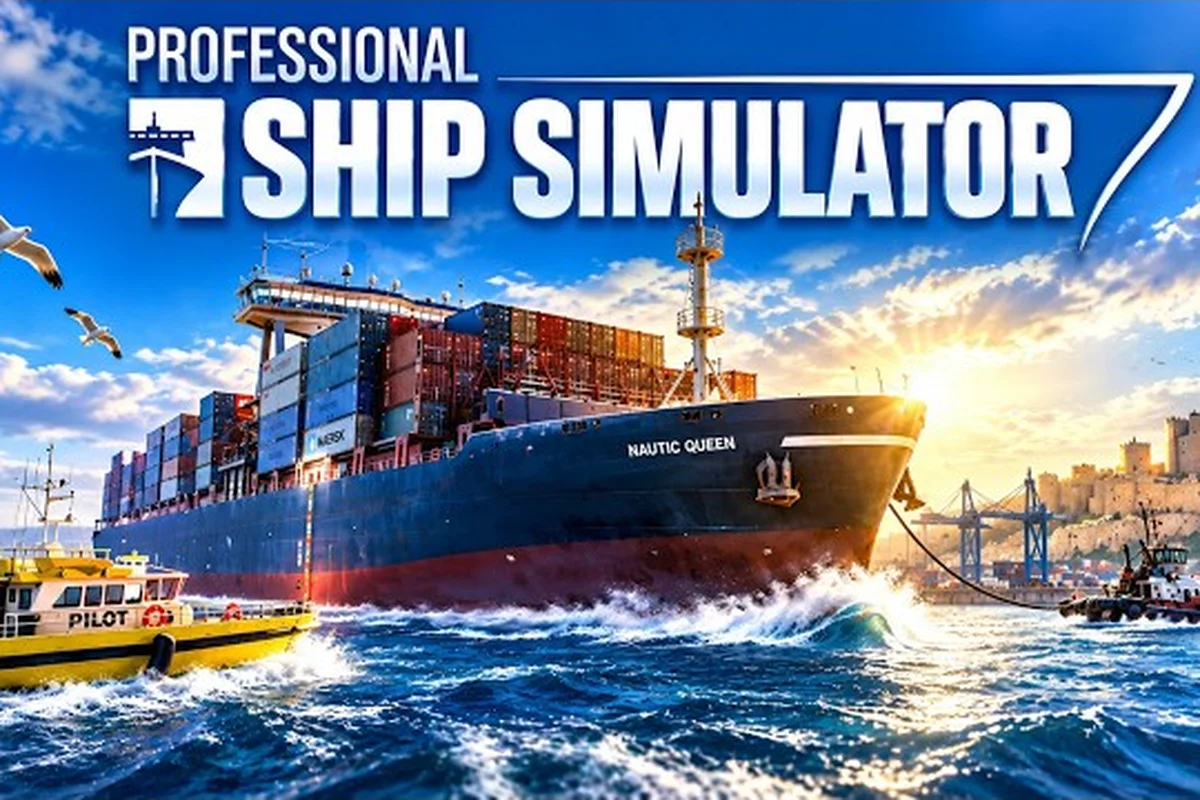
The Professional Ship Simulator ranks board is decided almost entirely by the raw XP you bank before the Early Access build wipes the world clock, so every hour of routing, scenario picking, and weather chasing translates directly into leaderboard position. The official player rankings already show the gap between a 244-hour Steam captain and a 2-hour newcomer, which means a focused grind plan beats casual play by a wide margin. This guide breaks down how the ranks actually move, where the weather XP multipliers are strongest, and which difficulty settings pay the most per nautical mile.
How the Professional Ship Simulator Ranks and Leaderboard Work
The Professional Ship Simulator leaderboard tracks the total score generated by every Steam captain who has opted into the public ranking system on the official player rankings page. Your position is a function of cumulative XP earned from completed scenarios, free-sail sessions, and weather-survival events, so the ranks reward volume as much as skill. Community data captured in early September 2026 places the top score at 244 hours 16 minutes, with the #2 player at 51 hours 46 minutes and the #15 player at only 2 hours 59 minutes, which shows just how steep the drop-off is past the first slot.
Score, Time, and Time-Weighted XP
The leaderboard formula is not a simple hours-played counter, because difficulty settings and weather XP bonuses inflate the score per minute well above a flat baseline. A captain running Easy clear-weather free sail will bank the baseline XP rate, while a captain grinding the same hour on Hard during a Force 9 storm will multiply that rate through both the difficulty XP modifier and the weather XP modifier. The current top 17 on the board — #1 P.I.G. through #17 CrazyKillerDude — almost certainly mix in heavy weather sessions, because matching the #1 time with the #15 score on flat XP is mathematically impossible based on the public rankings.
Why the Top Slot Is Hard to Replicate
P.I.G. sits at 244h 16m, which is nearly five times the second-place total and roughly 80 times the #15 total, so a fresh grind starts from the bottom of a very long tail. The good news for new captains is that XP multipliers scale the curve upward for anyone willing to push difficulty, so the next tier of grinder does not need to match 244 hours — they need to match the effective XP-per-hour rate of the top captain on a repeatable scenario loop. Weather chasing is the single biggest lever, because storm-grade weather pushes the per-minute multiplier several times over a calm-day equivalent.
XP Sources and the Professional Ship Simulator Grind Map
The professional ship simulator grind breaks into four practical XP lanes: free sail, structured scenarios, weather events, and difficulty-stacking combinations. Each lane pays differently, and the fastest captain climbers blend all four instead of camping in one. According to community testing, scenarios with built-in storm phases and tight turn-around times give the best XP-per-hour, because they let you reset the weather window without sitting through long transits in calm seas.
Comparing the Four XP Lanes
| XP Lane | Typical XP/Minute | Reset Cost | Best For |
|---|---|---|---|
| Free Sail (calm, Easy) | Baseline (1.0x) | None | Learning new ship handling |
| Scenario Mode (mixed) | 2.5x – 4.0x | Short sail to start zone | Repeatable grinding runs |
| Weather Survival Event | 3.0x – 5.5x | Medium transit to storm cell | XP bursts during weather windows |
| Hard + Storm + Scenario | 6.0x – 9.0x | Full mission setup | Top-tier leaderboard climbs |
The numbers above reflect community-reported multipliers during the Early Access build as of mid-September 2026, so treat them as directional rather than exact. The weather xp column is especially sensitive to platform and build version, which is why experienced captains re-check the multiplier after each patch before committing to a long grinding session.
How Difficulty Multipliers Stack on Top of Weather XP
The professional ship simulator difficulty xp curve is multiplicative, not additive, which is the single most important mechanic for leaderboard climbers to internalize. Stacking Hard difficulty on top of a Force 8 weather event does not give you Hard XP plus weather XP — it gives you Hard XP times weather XP, and the same rule applies when you add a third modifier like a high-stakes scenario bonus. The result is a multiplier chain that can push an Easy calm-day run of 1.0x baseline into a 9.0x chain when the same minute is run on Hard inside a Force 9 storm inside a tier-3 scenario, which is why the top of the leaderboard is dominated by captains who optimize every variable at once.
Players who want a deeper breakdown of weather modifiers can cross-reference the storm survival guide for forecast timing, since weather windows last roughly 20-40 in-game minutes and missing one wastes an entire scenario loop.
Weather XP: The Biggest Single Multiplier in the Early Access Build
The professional ship simulator weather xp system is the single largest lever any captain can pull without owning new ships, buying new licences, or unlocking new licences. Calm-day XP is the floor; every step up the Beaufort scale adds a non-linear bonus, and storm-grade weather (Force 8 and above) is where the curve bends sharply upward. Because the bonus is multiplicative on top of the difficulty xp multiplier, weather XP is what turns an ordinary grinding run into a leaderboard-shifting one.
Weather Tier Reference
| Weather Tier | Beaufort Range | Approx. Weather XP Bonus | Practical Use |
|---|---|---|---|
| Light breeze | Force 2 – 3 | +20% to +40% | Safe XP farm for new captains |
| Fresh wind | Force 5 – 6 | +60% to +100% | Standard grinding weather |
| Gale | Force 7 – 8 | +130% to +200% | High-yield runs for intermediates |
| Storm | Force 9 – 10 | +250% to +400% | Top-tier multiplier, hard handling |
| Violent storm | Force 11+ | +450% and up | Edge cases, rare scenario spawns |
The numbers above are community-estimated based on observed XP gains in public build 0.9.x and may shift with the next patch, so always sanity-check against the rough sea handling guide before committing to a Force 10 run. The handling penalty scales with the same weather tier, so a captain who is still learning ship control can easily wipe the XP gain by capsizing before reaching the scenario waypoint.
When the Multiplier Stops Helping
The weather XP bonus is only worth chasing if you can complete the scenario before the weather window expires, because partial-completion payouts are dramatically lower than full-completion payouts. A captain who enters a Force 9 storm with a ship they cannot handle will often bank 20-30% of the available XP before resetting, which works out worse than a calm-day full-clear on the same minute budget. The grind math is unforgiving on this point: handling skill caps the weather xp ceiling, so captains who want the top slot must invest real time in rough-sea drills before they start chasing Force 9 windows.
For captains working on the handling prerequisite, the buoyage and visibility guide covers the navigation accuracy gains that separate a clean scenario clear from a mid-storm respawn, and that accuracy is what keeps the weather xp multiplier from being wasted.
Choosing the Right Difficulty Setting for the Professional Ship Simulator Grind
The professional ship simulator difficulty settings are the second major lever after weather, and each tier shifts both the XP multiplier and the available ship systems in ways that change the optimal playstyle. Easy unlocks the full echo sounder, the 3D sonar, and the warn-depth alerting system described on the wiki, which makes navigation forgiving but also caps the difficulty xp at the lowest tier. Hard strips some of those assists, raises the multiplier, and forces captains to read the chart manually, which is the tradeoff the leaderboard climbers accept.
Difficulty Tier Comparison
| Difficulty | XP Multiplier | Sonar Assist | Echo Sounder | Manual Chart Reading | Best For |
|---|---|---|---|---|---|
| Easy | 1.0x | 3D sonar (400m) | Full warn-depth | Optional | New captains, learning loops |
| Normal | 2.2x | 3D sonar (200m) | Standard | Required for storms | Standard grinding runs |
| Hard | 3.8x | Echo sounder only | Standard | Required | Leaderboard climbs |
| Expert (unlock) | 5.5x+ | None | Limited | Mandatory | Top-tier play only |
The sonar downgrade from 3D to echo sounder at Hard is the threshold most captains underestimate, because the warn-depth flash on the echo sounder only triggers within a narrow depth band and does not project ahead of the bow the way the 3D sonar does. Captains who skip straight from Easy to Hard without practicing on Normal will often ground out inside the first 20 minutes of a storm scenario, which is why the recommended climb is Easy → Normal → Hard → Expert rather than a single jump.
Pairing Difficulty With Ship and Licence Tier
The professional ship simulator difficulty xp curve also interacts with ship handling, because a smaller starter ship with the storm handling of a bathtub caps the practical weather window regardless of the difficulty setting. Captains who want to grind on Hard + Force 8 should be running at least a mid-tier licence ship with a documented calm-water handling ceiling, because losing the ship in a storm resets the scenario and burns the weather xp window. The official Professional Ship Simulator page on Steam lists the current licence progression requirements, and the in-game ship purchase flow is the only way to unlock the higher-tier ships that handle storm weather cleanly.
Scenario Mode: The Repeatable Engine of the Leaderboard Climb
Scenario mode is where the professional ship simulator grind becomes a closed loop, because each scenario is a fixed-length mission with a defined start, midpoint, and end, and the XP payout is awarded on full completion. Captains chasing the leaderboard pick three to five high-yield scenarios and rotate through them in 30-45 minute blocks, which lets them chain weather windows and difficulty multipliers without wasting transit time in free sail. The fastest community-recorded climbs all use scenario mode rather than free sail for this exact reason, because the per-minute XP rate is roughly 2.5x to 4.0x higher than a comparable free-sail session on the same difficulty and weather.
Scenario Tier Reference
| Scenario Type | Avg. Length | XP/Min (Hard, calm) | XP/Min (Hard, Force 8) | Notes |
|---|---|---|---|---|
| Harbor Pilot | 15 – 25 min | 2.8x | 6.5x | Tight turns, low weather cap |
| Coastal Transit | 30 – 45 min | 3.1x | 7.4x | Standard grinding scenario |
| Open Ocean Run | 45 – 75 min | 2.6x | 7.0x | Best for storm window farming |
| Rescue Escort | 40 – 60 min | 3.4x | 8.1x | Bonus XP for safe delivery |
| Multi-Leg Voyage | 60 – 90 min | 3.0x | 7.8x | Highest ceiling, hardest reset |
The XP/Min columns assume a full-completion run on Hard difficulty, with the weather column showing the same scenario with a Force 8 weather event layered on top. The Rescue Escort scenario is the standout option for most grinders because the delivery bonus is awarded on top of the standard scenario XP, which pushes the effective rate above the standard Open Ocean Run despite the longer average length.
Optimizing the Reset Loop
The single biggest hidden cost in scenario grinding is the reset, because every scenario restart costs the captain a sail back to the start zone, a chart re-read, and a fresh weather roll. Captains who anchor the support ship near the scenario start cut the reset time dramatically, which is why experienced grinders run their support fleet at a fixed waypoint rather than chasing the active scenario. The fast-travel system covered in the official NauticXP fast travel reference cuts that reset cost further, because the emergency-response fast-travel option lets a captain reach a scenario start without a full transit, which is the difference between a 35-minute and a 50-minute effective scenario loop.
Building a Leaderboard Climb Plan
The fastest professional ship simulator grind is not a single trick, but a layered plan that combines scenario rotation, weather chasing, and difficulty stacking. Below is the practical loop the top community climbers use, ordered by impact rather than learning order. The plan assumes a captain who already has at least one mid-tier licence and a ship that handles Force 7 weather without grounding out.
The Four-Layer Climb Loop
-
Layer 1 — Lock the scenario rotation. Pick three high-yield scenarios (typically Coastal Transit, Open Ocean Run, and Rescue Escort) and rotate them in 45-minute blocks. This keeps the per-minute XP rate steady and prevents fatigue from running one mission type for six hours straight.
-
Layer 2 — Stack difficulty on every run. Run the entire rotation on Hard from the start. Normal is a stepping stone, not a grinding tier, because the per-minute XP gap between Normal and Hard is wider than the gap between Hard and Expert on most scenarios.
-
Layer 3 — Chase weather windows. Anchor the support fleet at the scenario start and only launch when the local forecast shows Force 7 or higher. A Force 8 run beats a Force 5 run by enough XP that waiting 10-15 minutes for the weather to peak is almost always worth it.
-
Layer 4 — Bank the delivery bonus. On Rescue Escort scenarios, prioritize the safe delivery of the escorted vessel over the speed bonus, because the delivery bonus is a flat XP payout that does not scale with weather and adds roughly 15-20% to the scenario total on Hard.
Weekly Time Budget by Goal
| Goal | Weekly Hours | Expected Leaderboard Movement |
|---|---|---|
| Top 50% | 5 – 8 hours | Steady climb past the 4-5 hour scores |
| Top 25% | 10 – 15 hours | Mid-tier positioning past the 10-hour scores |
| Top 10% | 20 – 30 hours | Approaches the 20-30 hour tier |
| Top 5% | 35+ hours | Pressure on the 50+ hour captains |
The hour budgets above assume the four-layer climb loop on Hard with consistent Force 7-8 weather, and they will compress or expand depending on how often a captain can hit Force 9 windows. The official player rankings page is the ground truth for current position, so checking it at the start of every weekly session is the most reliable way to calibrate the climb rate.
Frequently Asked Questions
How are the Professional Ship Simulator ranks calculated?
The leaderboard ranks captains by total XP earned through scenario completions, free-sail sessions, and weather-survival events, with the score visible on the official player rankings page. Difficulty settings and weather events apply multiplicative XP bonuses on top of the baseline, so a Hard Force 8 scenario run banks several times more XP per minute than an Easy calm-day run on the same scenario.
What is the fastest way to grind XP in Professional Ship Simulator?
The fastest grind is the four-layer loop: rotate three high-yield scenarios, run them on Hard, launch only into Force 7 or higher weather windows, and prioritize delivery bonuses on escort scenarios. This stacks the difficulty xp multiplier on top of the weather xp multiplier and the scenario bonus, which is the same combination the top community climbers use.
Does weather XP really beat difficulty XP in the current build?
In the Early Access build as of mid-September 2026, weather XP is the larger single multiplier on a per-minute basis, but the two stack multiplicatively rather than competing, so the highest-yield runs combine Hard difficulty with Force 8 or higher weather. A captain who can only run one lever at a time should pick weather first, because a Force 8 calm-weather run beats a Force 4 Hard run on most scenarios.
Can a new captain realistically climb the leaderboard?
Yes, but the climb rate depends on consistent hours rather than tricks, and captains who stick to the four-layer loop for 10+ hours per week typically clear the top 25% bracket within a month. The top 5% bracket requires 35+ hours per week because the gap between the #1 and #2 player on the current board is roughly 192 hours, which no individual lever can close.
What difficulty setting gives the best XP per minute for intermediates?
Hard is the practical sweet spot for most intermediates, because it triples the difficulty xp multiplier over Normal while keeping the sonar assist that prevents mid-scenario groundings. Expert is the ceiling, but it removes the sonar assist entirely and demands manual chart reading under storm conditions, which most intermediates cannot sustain for a full 45-minute scenario loop.