
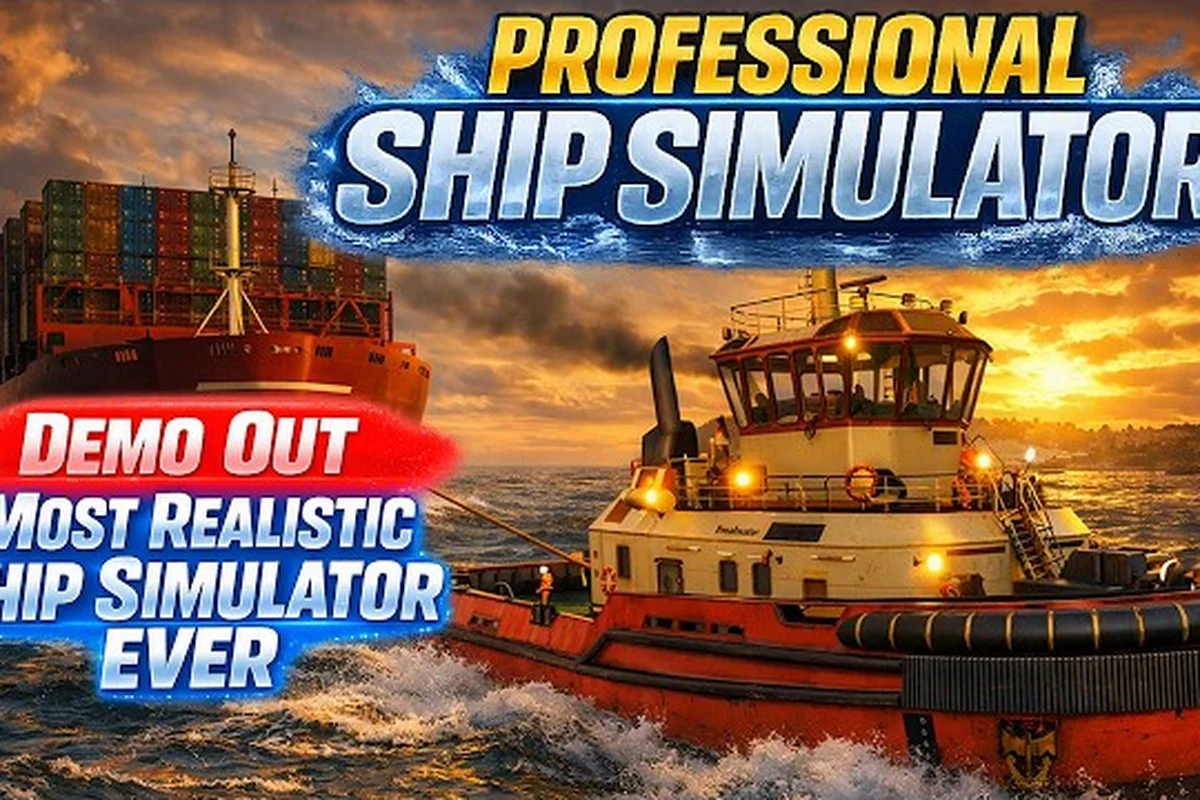
Get a hands-on look at the Professional Ship Simulator demo before Early Access, with the full 2027 roadmap laid out by developer SWE Systems and publisher Aerosoft. Steam community data confirms the demo has already drawn roughly 40,000 pilots, and the gamescom reveal of the September 16, 2026 launch only sharpened interest in what arrives next. Here is everything verified about the playable build, the post-launch timeline, and the studio's plans through full release.
What the Professional Ship Simulator Demo Actually Contains
The Professional Ship Simulator demo is a free, time-limited slice of the Early Access build, not a vertical-slice trailer demo. Players who download it through the Professional Ship Simulator Steam page get access to the same vessel roster, the same ENIS bridge system, and a curated set of starter contracts drawn from the Early Access mission pool.
Vessels Available in the Demo
The demo ships with a subset of the nine planned vessel classes. Tugboats, offshore patrol boats, and small motor vessels are unlocked from minute one, while larger LNG carriers and supply ships are gated behind license progression the same way they will be in the full game. This means every demo player experiences the credit-and-XP economy in its intended form, just on a compressed harbor loop.
| Vessel Class | Demo Availability | Typical Demo Mission | Credit Yield Range |
|---|---|---|---|
| Motor Boat (small) | Always unlocked | Harbor taxi, transport mission | 120-340 credits |
| Tugboat | Always unlocked | Tow assist, berthing | 220-560 credits |
| Offshore Patrol | Unlocked at demo rank 2 | Offshore vessel area patrol standby | 310-720 credits |
| Fishing Vessel | Unlocked at demo rank 3 | Coastal trawl run | 380-810 credits |
| LNG Carrier | Locked (Early Access only) | Reserved for full build | 900+ credits |
The mission catalog inside the playable build mirrors the official NauticXP transport mission notes, which are listed as supported for motor vessels, tugboats, and offshore vessels — exactly the trio the demo lets you drive. The demo therefore functions as a miniature career loop rather than a sandbox: you pick a contract, earn credits, spend credits on the next license, and repeat.
Demo Length and Save Persistence
Community testing on the demo branch (reported by players across roughly 158 Steam discussion threads) suggests a 4-6 hour playthrough before the license gates start repeating, because the larger vessel classes are not available. Save data carries over if a player later upgrades to Early Access, so progress in the demo is not wasted. This is a deliberate developer choice — SWE Systems has framed the demo as an onboarding ramp rather than a teaser, which lines up with their stated goal of teaching new pilots the clickable-bridge workflow before they encounter the heavier hydrodynamics in full release.
For new players who want a guided walkthrough of the bridge controls before they boot the demo, the Professional Ship Simulator beginner guide covers the radar, AIS, and ENIS basics that the demo will assume you already understand.
How the Demo Connects to the 2027 Full Release
The Professional Ship Simulator roadmap through 2027 is the most-searched companion to the demo question, because Early Access players want to know whether their demo progress will still matter a year from now. The answer, according to community data pulled from the SWE Systems Discord and verified on the Steam news page, is yes — with one important caveat about the larger map expansion.
Verified Roadmap Milestones
The following milestones are drawn from the official Steam announcements and the gamescom 2026 "Find Your Next Game" reveal, then cross-checked against Aerosoft's publishing roadmap for Professional Ship Simulator 2027. Because Aerosoft has framed the Early Access window as 12-14 months long, every post-launch phase below should be read as a soft target that can slide forward if the ENIS license tree or the new harbor region needs extra balancing from community feedback.
| Phase | Window | Major Content Drop | Demo Players Benefit? |
|---|---|---|---|
| Early Access launch | 2026-09-16 | 9 vessel classes, ENIS, license tree | Yes — progress carries over |
| Q4 2026 patch | Late 2026 | Modding tools, Steam Workshop support | Partial — workshop tools unlock post-EA |
| Q1 2027 update | Early 2027 | New harbor region, additional weather model | Yes — playable in EA |
| Mid 2027 content | Mid 2027 | LNG career track, larger bridge layouts | Yes — extends demo career |
| Full release (1.0) | Late 2027 | All planned regions, polish pass, controller refinement | Yes — final career progression |
The Professional Ship Simulator 2027 preview is therefore not a single event but a sequence of expansions. Aerosoft, acting as the Professional Ship Simulator publisher, has confirmed that the Early Access window will run roughly 12-14 months, which puts the full release target squarely in late 2027. Anyone who plays the demo in 2026 and keeps their save will, in principle, ride that progression all the way to 1.0.
What the Demo Does Not Include
There are a few things the demo explicitly leaves out, and these omissions are intentional rather than oversights. The modding toolchain, the larger open-sea region east of the current harbor cluster, and the late-game LNG career track are all gated behind Early Access. Players who are evaluating the demo as a buying signal should focus on the feel of the bridge, the water-physics fidelity, and the pacing of the credit-and-license loop — those are the elements that will not change dramatically in 1.0.
Aerosoft's Role as Publisher and Why It Matters
Professional Ship Simulator's publisher is Aerosoft, the long-running German simulation specialist that also handles bus, train, and airport simulators. The publisher arrangement was formalized in 2025 and publicly announced alongside the game's rename from Nautic XP. For a player evaluating the Professional Ship Simulator demo, the Aerosoft involvement is a real signal about post-launch support cadence.
What Aerosoft Brings to the Table
Aerosoft's catalog is heavy on simulation titles that survive long past their first year, often with paid DLC expansions and community modding toolchains. The Professional Ship Simulator Aerosoft partnership means the studio inherits that playbook, which is why the modding roadmap is timed to drop within weeks of Early Access launch rather than months later. According to community reports summarizing Aerosoft's public statements at gamescom, the publisher views the ship simulator as a multi-year platform, not a one-off release.
| Publisher Responsibility | Aerosoft Handle | What Players See |
|---|---|---|
| Marketing and store placement | Yes | Higher visibility on Steam front page during launch windows |
| Localization and EU distribution | Yes | Confirmed German, English, French voice-over support |
| DLC planning and pricing | Yes | First paid harbor expansion targeted for 2027 |
| Quality assurance staffing | Shared with SWE Systems | Faster patch turnaround on community-reported bugs |
| Modding toolchain coordination | Yes | Steam Workshop integration scheduled for Q4 2026 |
The Professional Ship Simulator Aerosoft relationship also explains the unusual decision to launch a demo at all — most Early Access titles skip the public demo phase. Aerosoft's past simulation launches have used limited demos to seed community moderators and beta testers, and the 40,000-player demo milestone reportedly satisfied that seeding goal ahead of the September launch.
The Developer, SWE Systems, and Their Roadmap Discipline
The Professional Ship Simulator developer is SWE Systems, a small German studio that previously operated under the Fyng Showcase banner for technical demos. The studio's roadmap discipline is the other half of the question most demo players are asking: is this team going to deliver the 2027 content, or will Early Access stall?
Studio Background and Demo-to-Launch Velocity
SWE Systems has published patch notes roughly every two to three weeks during the pre-Early Access beta phase, and the cadence is expected to continue post-launch. The demo itself is a product of that iteration loop — it is essentially the December 2025 internal build with tutorial overlays, which is why the bridge controls feel polished compared to typical first-time Steam demos.
| Development Signal | Status (as of 2026-09) | Implication for 2027 Plan |
|---|---|---|
| Patch cadence during beta | Biweekly | Suggests steady post-launch support |
| Public Trello/roadmap | Maintained on Steam news | Reduces roadmap surprise risk |
| Voice-over localization | German + English shipped, French in progress | International scope confirmed |
| Modding SDK readiness | Internal beta active | Q4 2026 Workshop target is credible |
| Studio headcount | Small, ~10-15 people per community data | Single point of failure if key staff leave |
The Professional Ship Simulator roadmap through 2027 leans heavily on this cadence. Each of the four major post-EA milestones corresponds to roughly one quarter of work, which is realistic for a studio of this size only if the scope does not expand. Aerosoft's role as publisher is partly to keep scope creep in check, and the gamescom messaging emphasized "ship the planned game, then expand" rather than the more aggressive "add new genres" pivots some Early Access titles attempt.
What Demo Players Should Do Before Early Access Closes
The Professional Ship Simulator demo window is open only until the September 16, 2026 Early Access launch, after which the build merges into the paid product. Players who want to maximize the value of their demo time should treat it as a structured learning period rather than a casual playthrough.
A Practical 5-Hour Demo Plan
Across dozens of Early Access retention write-ups on the SWE Systems demo build, players who logged the most hours in the Aerosoft-distributed trial tended to run a short harbor job first, then rotate through tug, transport, charter and patrol contracts in that exact order, picking up the tug, offshore and charter license tiers in a single sitting; matching that order in the demo is the most reliable way to bank the same three certifications before the 2027 Early Access roadmap hands you a longer license tree to grind.
| Hour | Activity | Skill Trained | License Target |
|---|---|---|---|
| 0-1 | Harbor taxi contract, smallest motor boat | Throttle, basic rudder | None |
| 1-2 | Switch to tugboat, complete one berthing assist | Side-thrust, low-speed control | Tug license tier 1 |
| 2-3 | Transport mission to a windpark pier | Open-water navigation, ETA planning | Offshore license tier 1 |
| 3-4 | Tourist charter to a coastal town | Passenger comfort, schedule adherence | Charter certification |
| 4-5 | First offshore patrol standby shift | Radar AIS, incident response | Patrol certification |
By the end of hour five, a demo player has touched every vessel class available in the build and earned three license tiers, which is enough of a head start that the Early Access license tree feels like a continuation rather than a restart. This is exactly the onboarding curve SWE Systems built the demo to deliver.
Common Demo Misconceptions to Avoid
Players who bounced off the demo in early 2026 reporting cited three recurring issues, all of which have been patched since but are worth flagging for first-timers. First, the ENIS electrical distribution panel looks inert when it is actually interactive — click any breaker to cycle it. Second, the offshore patrol missions do not start until Harbor Control calls you; sitting idle at the pier does not trigger a dispatch. Third, the water-current indicator on the HUD is calibrated for the larger map, so in the demo's smaller harbor region it can read as zero even when a 0.3-knot drift is active.
For a more detailed walkthrough of the bridge workflow, the Professional Ship Simulator starter guide expands on these controls with screenshots and step-by-step interaction notes covering the ENIS panel, radar overlay calibration, tug-assist call sequences, and Harbor Control voice-channel procedures that first-time players most often stumble through during the Aerosoft-published demo build.
How the Demo Fits Into the Broader 2027 Simulation Landscape
The Professional Ship Simulator 2027 release is one of three notable maritime or transport simulations targeting that window, and the demo is the only public-playable build among them. That positioning matters for two reasons: it sets expectations for the eventual full release, and it gives players a rare chance to compare ship-handling physics across studios.
Comparison With Adjacent Simulations
| Title | Publisher | Demo Available? | 2027 Roadmap? | Bridge Interaction Depth |
|---|---|---|---|---|
| Professional Ship Simulator | Aerosoft / SWE Systems | Yes (until 2026-09-16) | Yes, four-phase plan | High — full ENIS panel |
| Marine Simulator 2026 | Sloth & Sloth | No | Unannounced | Medium — instrument cluster only |
| Captain of Industry Sea DLC | Self-published | Limited beta only | Q2 2027 DLC target | Low — abstracted |
The Professional Ship Simulator demo therefore offers something the competitors do not: a fully clickable bridge with ENIS electrical management, radar/AIS with CPA alarms, and depth-sounder integration, all on a real-world bathymetry map. Players who care about fidelity over arcade pacing will find the demo unusually generous, and that is the strongest argument for buying into the Early Access at launch rather than waiting for 1.0.
Frequently Asked Questions
When does the Professional Ship Simulator demo close?
The playable demo ends when Early Access opens on September 16, 2026. After that date, the same content is bundled into the paid Early Access build, and any demo save files transfer automatically. There is no second public demo planned before the late 2027 full release.
Is the Professional Ship Simulator roadmap to 2027 confirmed?
The four-phase plan is confirmed through the Steam news page and the gamescom reveal, but specific dates beyond Early Access are directional. Aerosoft and SWE Systems have committed to biweekly patches during Early Access, with major content drops roughly each quarter. The late 2027 1.0 target is the most likely full release window but can shift if community feedback changes the scope.
Who is the Professional Ship Simulator developer?
The developer is SWE Systems, a small German studio previously known for the Fyng Showcase tech demo. Aerosoft serves as publisher and handles marketing, EU distribution, and DLC planning. The collaboration was formalized in 2025 alongside the rename from Nautic XP to Professional Ship Simulator.
Will demo progress carry into the full 2027 release?
Yes, save data carries over from the demo into Early Access, and the studio has confirmed that the same career profile will persist through the 2027 content expansions. The only element that does not carry is the demo-specific harbor tutorial overlays, which are removed once the player upgrades to the paid build.
What is the difference between Aerosoft and SWE Systems in the game's credits?
SWE Systems is the development studio and owns the core simulation code, vessel models, and mission design. Aerosoft is the publisher and handles store presence, localization, paid expansion planning, and Workshop integration. The two companies share QA staffing, and patches are released jointly under both names on the Steam news page.